Four became one. Zimbabwe's listed property structure has flipped in five years.
 By Location.ZW Research
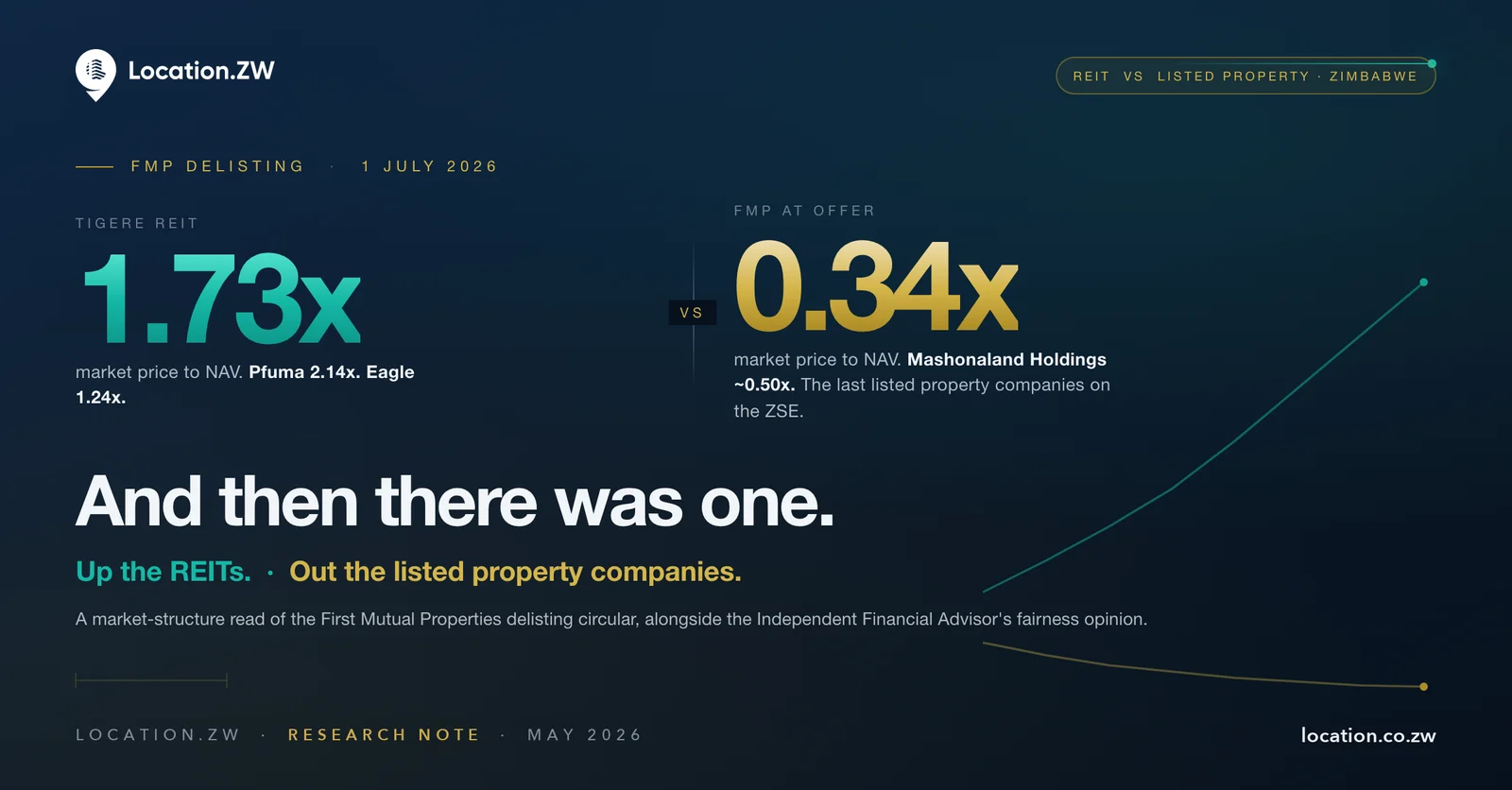
Up the REITs. Out the listed property companies. A market-structure read of the First Mutual Properties delisting circular, alongside the Independent Financial Advisor's fairness opinion.
A decade ago the Zimbabwe Stock Exchange carried four listed property counters: Mashonaland Holdings, Zimre Property Investments (the listed successor to National Real Estate, since rebranded as Zimre Property Services), Dawn Properties, and First Mutual Properties, each a corporate property operating company, listed under the standard companies regime. Today, three of those four have already exited the exchange or are exiting it. In their place, a new generation of property-holding structure has emerged: the real estate investment trust.
The arc compresses neatly into a 60-year timeline.
| Year | Event |
|---|---|
| 1969 | Mashonaland Holdings becomes the first dedicated property counter listed in Harare. |
| 27 January 2003 | Zimre Property Investments is incorporated following the disposal of National Real Estate (Pvt) Ltd, its operating predecessor, and lists on the ZSE (the operating business has since rebranded as Zimre Property Services). |
| 2003 | First Mutual Properties (then Pearl Properties) is incorporated and joins the ZSE in the same year. |
| 10 November 2020 | Zimre Property Investments (ZPI) delists from the ZSE following acquisition by parent Zimre Holdings. |
| 16 February 2021 | Dawn Properties delists following the vertical acquisition by African Sun. |
| 30 November 2022 | Tigere REIT lists on the ZSE, Zimbabwe's first real estate investment trust. |
| 29 April 2023 | WestProp Holdings lists on the VFEX, Zimbabwe's first listed property development company. WestProp is a developer, not a stabilised-income operating company, and sits in a different operational category from the entities analysed in this note. |
| 18 December 2023 | Revitus REIT lists on the ZSE, Zimbabwe's second REIT, with a regenerative mandate to acquire distressed urban commercial property and redevelop it. |
| 16 May 2025 | Eagle REIT lists on the Victoria Falls Stock Exchange (VFEX), Zimbabwe's first USD-denominated REIT. |
| 6 February 2026 | Pfuma REIT lists on the VFEX, second USD-denominated REIT, USD-priced at issue. Original listing date of 4 February was deferred by two days. |
| 1 July 2026 | First Mutual Properties is scheduled to delist from the ZSE. |
After 1 July, Mashonaland Holdings will be the only listed property operating company on the Zimbabwe Stock Exchange. Alongside it on the ZSE, two REITs (Tigere and Revitus). On the VFEX, two more REITs (Eagle and Pfuma) plus WestProp Holdings, a listed property developer that sits in a different operational category from the stabilised-income operating companies analysed in this note. The structure of Zimbabwean listed property has flipped in five years. Of the three REITs for which Intellego's Independent Financial Advisor opinion records reliable comparable-trading data, all three trade at premiums to net asset value of between 1.24 and 2.14 times. Revitus, the fourth REIT, is in a category of its own, and is worth a closer look later in this note.
The First Mutual Properties (FMP) Circular to Shareholders, published on 11 May 2026, sets out the terms on which the parent company will buy out FMP's minority shareholders ahead of the delisting. It also contains, in the Independent Financial Advisor's Fairness and Reasonableness Opinion, the full comparable-counter analysis that explains why one property-holding structure in Zimbabwe trades at over 2x its book value while another trades at one-third of it.
The structural divergence is the most important market-design story in Zimbabwean real estate this decade.
The deal in brief
First Mutual Holdings Limited (FMHL), which owns 70.80% of First Mutual Properties, has offered its minority shareholders US$0.033 per share in cash to exit ahead of the delisting. The offer is underwritten up to 4.11% of the issued share capital by Morgan & Co. The Extraordinary General Meeting is on 2 June 2026, the offer closes 24 June 2026, and the company is scheduled to be removed from the Main Board of the ZSE on 1 July 2026.
A note on conditionality: the delisting is subject to shareholder approval at the 2 June EGM, which requires a 75% majority of the non-conflicted minority. With FMHL already holding 70.80% of issued capital and the resolution structured to its preference, the vote is heavily expected to pass, but the rest of this analysis assumes that approval is granted. Any reference below to FMP "delisting", to Mashonaland Holdings becoming "the only" listed property operating company on the ZSE, or to the post-1 July market structure should be read with that conditionality in mind.
The Independent Financial Advisor, Intellego Investment Consultants, has opined that the offer is fair and reasonable to minority shareholders, applying a blended valuation methodology that combines two reference points in a 60:40 ratio: an income capitalisation Net Asset Value (NAV), and the 30-day Volume Weighted Average Price (VWAP) at which FMP shares have actually traded. The 9.3% premium of the offer to the central blended scenario value of US$0.0302 supports the fairness conclusion under that framework.
The same opinion makes two further points that institutional readers should not overlook.
The first is what the offer represents against the property portfolio's audited fair value:
- FMP IFRS Fair Value NAV per share: US$0.0867
- FMP book NAV per share: US$0.0966
- FMP offer price: US$0.0330
The offer represents 38% of IFRS NAV, or in other words a 62% discount to the long-run fair value of the underlying property portfolio (US$0.0330 ÷ US$0.0867 = 38.1%; Intellego rounds the same calculation to "approximately 35%"). Intellego itself records that "the Offer does not fully compensate minority shareholders for the embedded long-run value of the portfolio."
The second is what a fairness opinion is contractually designed to cover. Section 2 of the IFA letter sets the scope precisely:
"We have not been engaged to advise on, and this Opinion does not address, the commercial merits or strategic rationale of the Proposed Delisting, the tax consequences to individual shareholders of accepting or declining the Offer, the future financial performance of FMP as an unlisted entity, or any other matter not expressly within the scope of a fairness and reasonableness opinion."
That is a properly disciplined scope, and it leaves the broader market-structure conversation as a natural complement, sitting next to the IFA's analysis rather than competing with it. The rest of this note is that complement.
Why are listed property counters delisting in Zimbabwe?
The IFA's comparable-counter analysis sets out the structural answer directly:
| Counter | Type | Multiple to NAV |
|---|---|---|
| Tigere REIT | REIT | 1.73x |
| Pfuma REIT | REIT | 2.14x |
| Eagle REIT | REIT | 1.24x |
| Mashonaland Holdings | Listed property company | ~0.50x |
| First Mutual Properties (at offer) | Listed property company | 0.34x |
| STANLIB Fahari (Kenya REIT) | Frontier comparable | 0.51x |
| ILAM Fahari (Kenya REIT) | Frontier comparable | 0.46x |
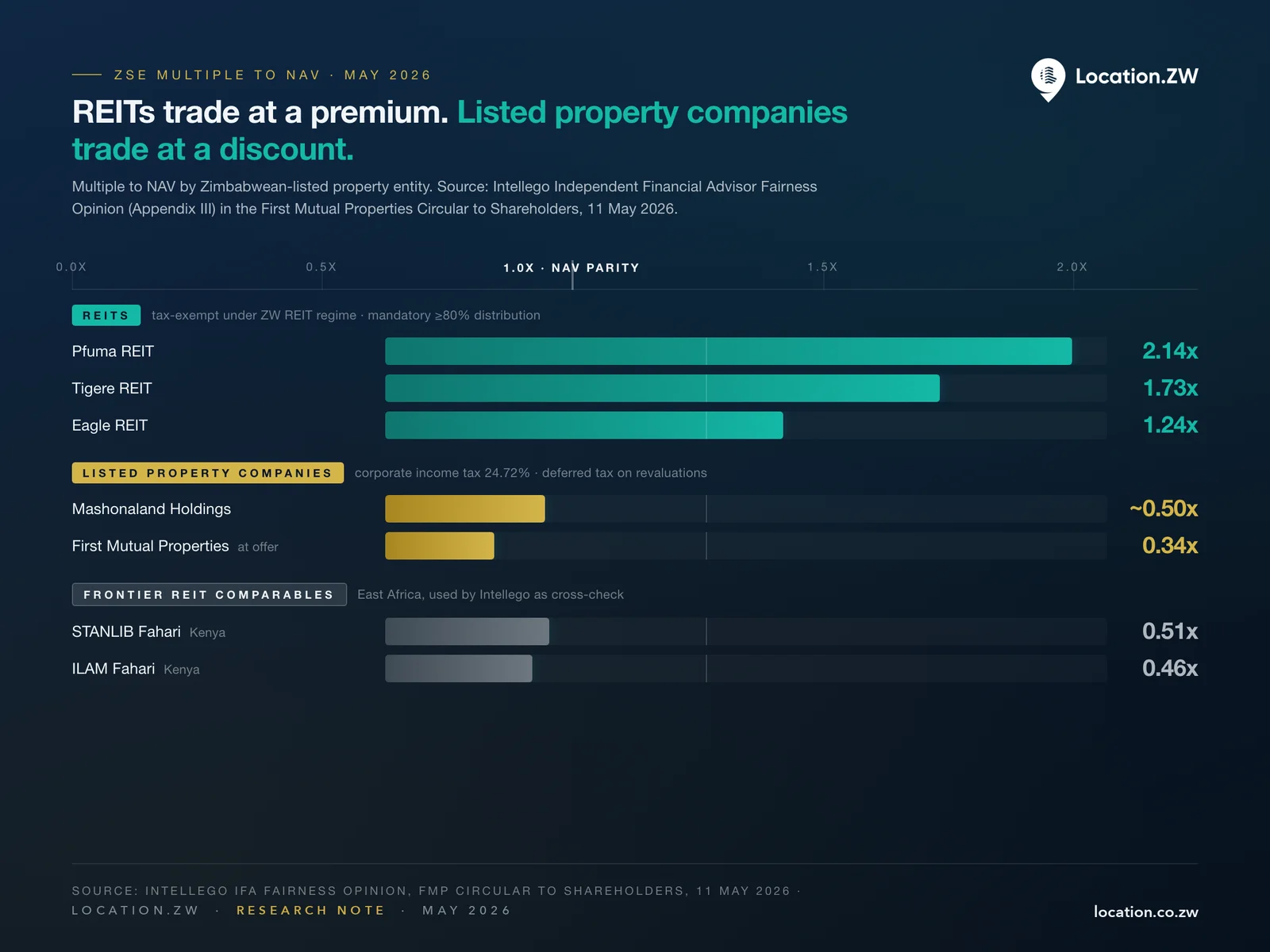
Same country. Same property market. Same currency. The price gap between a listed property company and a REIT in Zimbabwe is between 2x and 6x on the multiple.
The mechanical reason is tax.
A listed property company in Zimbabwe pays corporate income tax at 25.75% on profits (the 25% corporate rate plus the 3% AIDS levy, effective 1 January 2024). It accumulates a deferred tax liability on every property revaluation surplus. First Mutual Properties currently carries US$17,118,906 of deferred tax liability on its balance sheet, of which Intellego identifies US$17,521,160 as arising specifically from investment property revaluation surpluses (Note 14 to the audited financials). The fact that the property-revaluation DTL is slightly larger than the net DTL on the balance sheet means small deferred tax assets, typically credit-loss allowances and similar timing differences, are offsetting elsewhere, but the DTL is for practical purposes a property-revaluation liability. It is a structural encumbrance on equity value that does not disappear when the company delists. It will only ever crystallise if the underlying properties are sold.
A Real Estate Investment Trust under the Zimbabwean regime, by contrast, is generally exempt from corporate income tax, distributes the majority of taxable income mandatorily to unitholders, and passes capital gains through rather than warehousing them at corporate level. The two structures hold the same kind of property and produce the same kind of rent. They are priced very differently because they generate very different after-tax cash for the holder.
There are secondary contributors to the listed property company discount: persistent illiquidity (FMP turned over just 0.27% and 0.20% of issued share capital in 2024 and 2025 respectively), an aging IFRS desktop revaluation (the last physical inspection of the FMP portfolio was January 2023, three years and three months ago), short Weighted Average Unexpired Lease Terms (FMP's WAULT is 2.46 years with approximately 33% of the portfolio's gross lettable area, or GLA, expiring within 12 months), and conglomerate discounts on holding structures. But the tax wedge is the dominant factor.
The market has been pricing it for years. The structural lesson is that the standard companies regime is not a viable home for a property-holding entity that intends to remain publicly listed in Zimbabwe.
International benchmarks: how do these multiples compare?
The Intellego comparable table is calibrated entirely against Zimbabwean and East African REITs. A useful sanity check is how the Zimbabwean multiples sit against more developed markets.
Recent published valuations (early 2026):
| Market / sector | Median P/NAV multiple |
|---|---|
| US REITs (all sectors, S&P Global Market Intelligence, end-January 2026) | 0.84x (16.2% discount) |
| US Office REITs | 0.66x (33.6% discount) |
| US Hotel REITs | 0.67x (33.5% discount) |
| US Healthcare REITs | 1.25x (24.9% premium) |
| US Data Center REITs | 1.01x (1.3% premium) |
| UK major commercial REITs (Land Securities, British Land, recent range) | ~0.65x to 0.85x |
| South African REITs (2025 to 2026 rally, discounts narrowing) | typically 0.85x to 1.00x |
| Kenyan REITs (STANLIB Fahari, ILAM Fahari) | 0.46x to 0.51x |
| Zimbabwean REITs (Tigere, Eagle, Pfuma) | 1.24x to 2.14x |
The Zimbabwean numbers stand out. Tigere REIT's 1.73x multiple is higher than the highest-premium US sub-sector (Healthcare at 1.25x). Pfuma's 2.14x sits above any major-market REIT category tracked by the published global indices. That is not the typical frontier-market pattern. Frontier-market property REITs usually trade at discounts to NAV, as the Kenyan comparables in the Intellego report demonstrate (0.46x to 0.51x).
So why are the Zimbabwean REITs the outlier? Four drivers, each material:
- USD-yield scarcity. Zimbabwean REITs distribute mandatorily, with USD cash dividends a feature of the listed product set. In an economy with persistent currency volatility and policy risk on the ZWG, a hard-currency yielding asset bought on the local exchange is one of the few inflation-protected USD income streams accessible to local investors without breaching exchange controls. Demand for that yield is structural and price-insensitive at the margin.
- Constrained supply. Five listed REITs in total across the ZSE and VFEX, with a combined market capitalisation a small fraction of institutional demand from local pension funds, insurance balance sheets, and diaspora retail. Constrained supply meets concentrated demand. Marginal pricing is set by the buyer, not the seller.
- Mandatory distribution discipline. The REIT regime forces approximately 80% of taxable income to flow through to unitholders quarterly. In a market where listed companies otherwise retain almost all cash (FMP and Mashonaland Holdings both retained over 94% of profit in their most recent reporting years), the distribution discipline is itself a value proposition that the market pays a premium for.
- NAV reporting conservatism. Zimbabwean commercial property valuations are typically based on desktop revaluations against historic transaction comparables, in a market where transactional liquidity is thin. The audited IFRS NAVs may be conservative relative to USD replacement cost or international fair-value benchmarks. To the extent NAVs are understated, the "premium to NAV" is partly an adjustment to a fairer mark rather than a true premium. This matters for the FMP analysis too: if FMP's IFRS NAV of US$0.0867 per share is itself conservative, the offer at US$0.033 represents an even larger discount to true fair value than the 62% headline.
The implications are different for each driver. Drivers 1 to 3 (scarcity-driven yield premium) are partially self-sustaining as long as the macro conditions persist. Driver 4 (NAV conservatism) is a structural understatement of true value across the listed property and REIT universe in Zimbabwe, and supports the conclusion that the FMP offer is not just discounted against IFRS NAV but against a fair value that is probably higher than the IFRS-reported figure.
Premium pricing, USD yield, frontier volatility: what is the risk-adjusted picture?
Premium-to-NAV multiples and USD dividend yields of 6 to 12 percent are an unusual combination. In conventional theory, a premium to NAV implies the market expects future income growth or asset value uplift. A high running yield typically compensates for elevated risk. The Zimbabwean REIT universe is delivering both at the same time, which is a strong signal that the market is pricing a specific risk-return trade-off rather than a pure-yield or pure-growth thesis.
The risk side of that trade is real and material:
- Currency and policy risk. The ZWG remains fragile and statutory-instrument changes have historically reshaped market structures with limited notice. Even USD-denominated VFEX REITs face translation and repatriation friction relative to the legal domicile of the underlying assets.
- Concentration risk. Each Zimbabwean REIT holds a small number of assets relative to international peers. Tigere's portfolio is built around Highland Park and Chinamano Corner. Pfuma's is seeded with Chegutu Retail Centre and Hogerty Hill. Single-asset events have outsized portfolio impact.
- Liquidity risk. Trading volumes are thin. Revitus's 12.6% single-session price drop on 28 April 2026 illustrates how rapidly marginal-buyer sentiment can re-price a position. Exiting large positions can be slow and price-impactful.
- Tenant concentration and related-party exposure. Several listed property entities count their parent group as a material tenant or counterparty. This is true at FMP (FMHL is the dominant occupant, per Intellego), and similar dynamics exist at smaller REITs.
For a Zimbabwean institutional investor (pension fund, insurance balance sheet, corporate treasury), these risks are partially offset by the alternative being held: cash in a fragile-currency environment, equities in a thin-trade market, or local-bond exposure with sovereign risk. Against that opportunity set, a premium-to-NAV USD-yielding REIT may still offer the best risk-adjusted carry available.
For an international investor (frontier-allocation pension fund, regional Africa specialist, diaspora private wealth), the diversification proposition is the more compelling case. Zimbabwean REIT returns are largely uncorrelated with developed-market REIT cycles, with developed-market property equities, and even with continental African property indices. In a diversified frontier-Africa allocation, a small Zimbabwean REIT weight can improve portfolio Sharpe meaningfully without taking on outsized single-country exposure, even after accounting for the volatility risks above.
The structural argument running through this note has so far focused on why listed property operating companies are leaving the exchange. The corollary is constructive for the REIT side of the market: the premium pricing is, partly, the market saying it wants more REITs to invest in.
For investors wanting to model the risk-return-diversification picture against a specific portfolio, Property Intel's REIT Optimizer runs the full Sharpe-ratio, correlation and weighting analysis across the Zimbabwean REIT set, using the same inputs that drive this analysis.
Open the REIT Optimizer →A caveat: not all REITs trade the same
Before pushing the structural argument too hard, a note on Revitus. Revitus is the only Zimbabwean REIT that does not appear in the IFA's comparable-trading table because Intellego specifically excluded it from the "reliable data" set. The reason is that Revitus is not a stabilised income REIT. Its published mandate, summarised by the fund itself, is to redesign, renovate, and regenerate, that is, to acquire distressed urban commercial property and reposition it as modern green-rated stock. The REIT was seeded with legacy property assets from the National Railways of Zimbabwe (NRZ) Contributory Pension Fund. Its trading record on the ZSE has been bumpy: a 12.6% single-session price drop on 28 April 2026 against a ZWG 2.65 to ZWG 2.32 print, on volumes well below the established ZSE property counters.
The Revitus thesis is, on its face, the most interesting in the market. A pipeline of distressed assets bought cheap, redeveloped to institutional-grade specification, and re-let into a market starved of modern stock is a defensible value-add story. Whether the public market is the right place to express that thesis at this point in the development cycle is a separate question, value-add real estate is generally a poor fit for daily-priced equity markets because the asset isn't producing stabilised income while it's being redeveloped. The Revitus discount, if and when it stabilises into a NAV multiple, will tell us something about how the Zimbabwean market prices delivery risk inside a tax-efficient structure.
For the purposes of this note, then, the relevant REIT comparables for FMP are Tigere, Eagle, and Pfuma, three stabilised-income vehicles trading at 1.24x to 2.14x NAV. Revitus is a different exercise.
The arithmetic of a REIT conversion
Here is the question we expect any institutional investor to ask. Why doesn't First Mutual Properties simply convert to a REIT instead of delisting?
The arithmetic is straightforward.
- FMP IFRS Fair Value NAV per share: US$0.0867
- Tigere REIT premium to NAV: 1.73x
- Implied per-share value at Tigere's multiple: approximately US$0.150
- Offer price: US$0.033
A REIT-converted First Mutual Properties could imply a per-share value approximately 4.5 times the offer price. Without selling a single building. Without raising new capital. Without changing the rent roll.
That is not the unrealistic high end of a research note. It is the multiple at which the Zimbabwean REIT market is currently and observably pricing a very similar pool of underlying property cash flows.
The structural question worth asking alongside the fairness opinion
The Chairman's letter offers four reasons for the delisting: greater flexibility in capital raising, more efficient execution of corporate actions, structuring and tax planning flexibility, and strengthened strategic focus. All four are true. None of them explains why a REIT conversion was not pursued instead, given the multiple-uplift available.
The strategic answer is in the structure of the parent.
First Mutual Holdings is a diversified financial services group: life assurance, short-term insurance, health insurance, property investment, and wealth management. The First Mutual Properties portfolio of US$136 million of investment property is more than a financial return stream for that group. It is an internal treasury, a collateral pool, and a strategic asset. Crucially, it is held within four 100%-owned subsidiaries (Builstate Investments, Greencroft Properties, Arundel Office Park, and Sticklip Enterprises) plus participations in associates including Infrastructure Fund Zimbabwe (solar) and the FMP property and student-accommodation funds. Each subsidiary holds separately titled properties.
That nested structure is built for flexibility. Each asset can be encumbered, pledged, restructured, or carved out for specific group purposes without disturbing the rest. A REIT structure constrains all of that.
A REIT conversion would impose:
- Mandatory distribution of approximately 80% of taxable income (cash trapped at REIT level, no longer redeployable across the broader group)
- Independent trustee oversight and arms-length operating discipline (tightening intercompany lease pricing and cross-tenanting flexibility, particularly significant given the IFA notes that FMHL is itself "the dominant occupant" of FMP property)
- Constraints on using individual properties as collateral for parent-group facilities
- Reduced ability to restructure via special purpose vehicles, intercompany lending, and capex redirection, all of which the Chairman's letter explicitly cites as benefits of going private
In other words: the persistent NAV discount on listed property companies is a market signal that the controlling shareholder is extracting non-financial value from the corporate structure. This is not market manipulation. It is rational behaviour by a controlling shareholder. Strategic control of physically separated, individually titled property assets is itself a financial asset, just not one that shows up on the income statement.
Is it really only structure? A portfolio fundamentals check
The structural argument is powerful, but it is not the whole picture. Before concluding that the FMP discount is purely a function of tax form and controlling-shareholder behaviour, it is worth asking the obvious operational question. Is part of the discount actually about the assets?
The FMP portfolio is roughly 124,000 square metres of lettable area across 41 buildings in Zimbabwe's major urban centres. The mix is diversified: high-rise CBD offices, office parks, suburban retail, industrial and warehouse, with smaller residential and student-accommodation exposures through associates. Recent published management commentary reports portfolio-wide occupancy around 86.5%, a respectable headline number, but the sector mix matters more than the average:
- Office parks occupancy slipped from 89.62% to 83.42% in the most recent reporting period, a 6-point drop, partly transitional but partly real.
- Industrial is the weakest sector, dragged by low capacity utilisation in Zimbabwe's productive economy and reflecting the steepest occupancy decline of any FMP segment.
- Retail and core office demand remains relatively firm.
- WAULT is 2.46 years area-weighted, with approximately 33% of gross lettable area expiring within 12 months (per Intellego's IFA opinion). For a stabilised income portfolio, that headline figure is short, but it is also a misleading metric in this market, and that deserves a separate note.
A note on WAULT and tenant covenant on the FMP portfolio
Headline WAULT measures the weighted average time to contractual lease expiry. It tells you when the leases end on paper, not how reliably tenants stay. For an institutional investor reading this metric, the tenant covenant mix is what really matters, and that is where the FMP portfolio looks materially better than the headline WAULT figure suggests.
FMP's published tenant list points to a blue-chip and multilateral covenant base: UN Agencies, TM Supermarkets, PwC Chartered Accountants, and First Holdings (the parent FMHL) Group subsidiaries are among the named occupants. Tenants of that class are historically poor candidates to exercise contractual break clauses where they exist, and renew at very high rates. Multilateral and NGO tenants in particular tend to renew because relocation involves operational disruption, security re-assessment, and host-country protocol that argues against short-cycle moves. Blue-chip corporates and dominant national retail chains exhibit the same renewal pattern for fit-out, brand-location and operational-continuity reasons.
The implication for FMP is that the effective income visibility on the portfolio is materially longer than the headline 2.46-year contractual WAULT suggests. A property book held by a covenant pool of UN Agencies, Big Four accountants, dominant retail chains and group-related tenants is not in practice a 2.46-year income asset. It is a longer-duration asset whose lease-renewal economics are usually settled well before contractual expiry.
That changes how heavily WAULT should weigh in the discount-to-NAV story. A short contractual WAULT against a strong-covenant tenant pool is a substantially different proposition from a short WAULT against an SME tenant pool with rolling break risk. The market is not pricing the strong covenant base into a reduced equity discount. The discount sits structurally on the tax and capital-allocation argument, not on income-visibility risk.
One caveat worth flagging: FMP's audited FY2025 numbers report a US$398,572 provision for credit losses plus US$165,389 of bad debts written off, cutting NPI by approximately 12%. That provision sits awkwardly with a strong-covenant tenant headline, and either reflects tail-risk on smaller non-blue-chip tenants in the portfolio, currency-conversion timing across the rent roll, or specific arrears matters the Circular does not break out. The notes to the audited statements (excluded from the Circular under the ZSE simplified-disclosure permission) would disclose the composition.
The IFRS NAV vs Income Cap NAV gap is itself a fundamentals story
There is one more piece of the fundamentals picture worth surfacing because it is buried in the technical detail of the Intellego methodology. The two NAV references the report uses are very different in what they measure:
- The IFRS Fair Value NAV (US$0.0867 per share) reflects long-run income potential at estimated rental value (ERV) at stabilised occupancy, what the portfolio could generate if it were fully tenanted, well-maintained, and producing market rents.
- The Income Capitalisation NAV (US$0.0241 to US$0.0375 per share across Intellego's three scenarios) reflects current audited NPI of US$4.57M capitalised at 8.5% to 9.5%.
The gap between those two numbers is a fundamentals gap, not a methodological one. Intellego is explicit about this, they describe the IFRS Fair Value as "long-run income potential" and note "the conservative effect of FMP's operating cost structure and write-offs on audited NOI" (Net Operating Income, the same concept FMP reports as Net Property Income in its audited statements). Two operational facts compound this:
- Operating cost structure and write-offs. In FY2025 FMP's revenue of US$8.97M produced an NPI of only US$4.57M after property expenses (US$3.84M), provision for credit losses (US$0.40M), and bad debts written off (US$0.17M). The provision for credit losses and bad-debt write-offs alone reduced NPI by approximately 12%. A stabilised portfolio with cleaner receivables would deliver a meaningfully higher NPI.
- Uncommitted CAPEX. Per the Circular Section 6, as at 31 December 2025 FMP had no capital expenditure contracted but not yet incurred, and "all planned capital expenditures remain uncommitted." For a portfolio whose IFRS Fair Value implicitly assumes stabilised income at ERV, an absence of provisioned CAPEX to maintain or upgrade the asset base is a meaningful signal that the IFRS NAV may overstate near-term cash-generating capacity.
In plain language: the IFRS Fair Value NAV is what the portfolio could deliver. The Income Capitalisation NAV is what it actually does deliver right now. Closing the gap between the two requires investment that is not currently provisioned. That is a fundamentals point, not a structural one.
How much of the discount can fundamentals explain?
The honest answer is: some, but not most. The strong tenant covenant base (UN Agencies, Big Four, dominant retail chains, FMHL group subsidiaries) means income-visibility risk is materially smaller than the headline 2.46-year WAULT suggests. The remaining operational drag, an 86.5% occupancy headline with industrial sector weakness, write-offs depressing audited NPI by approximately 12%, and uncommitted CAPEX needed to lift the portfolio to ERV, could reasonably support a NAV discount in the order of 15 to 25 percent. That is meaningful. But the FMP offer prices the equity at 62% below IFRS fair value. The fundamentals can plausibly explain the first 15 to 25 points of that gap. The remaining 37 to 47 points sit much more naturally with the structural, tax, and control argument above. Operational performance is part of the story. It is not the headline.
The cash that actually reaches the holder
A still sharper way to express the difference is at the level of distributable cash. The listed property company and the REIT both own buildings that produce rent. They distribute that rent to shareholders very differently.
| Vehicle | FY most recent | Property value (book) | NPI | NPI yield on book | Distribution | Yield at market price |
|---|---|---|---|---|---|---|
| First Mutual Properties | FY2025 (audited) | US$136.1M | US$4.57M | 3.36% | US$182,800 (US$0.000148/share) | ~0.45% at offer US$0.033 |
| Mashonaland Holdings | FY2024 (audited) | US$91.6M | ~US$3.01M op profit | 3.28% | US$230,000 (US$0.000136/share) | ~0.2 – 0.5% |
| Tigere REIT | FY2025 | US$59.5M NAV | Distrib. income/unit +23.2% | n/a (distrib-driven) | US$0.00228/unit, 103% payout | ~6 – 12% USD |
| Pfuma REIT | Q1 2026 (interim) | US$23.7M seeded | ~7% gross yield target | n/a (early days) | US$0.000948/unit, 80% mandatory | Target 7 – 8% USD |
| Eagle REIT | Listed May 2025 | US$24.5M PP seeded | n/a (early) | n/a | 80% mandatory distribution | Target comparable to Tigere/Pfuma |
Three things to read out of that table.
First, the operating yields are not that different. FMP delivers a 3.36% NPI yield on book value. Mashonaland Holdings delivers 3.28%. Pfuma's targeted gross rental yield at full occupancy is around 7%. These are not orders of magnitude apart at the property level, Zimbabwean commercial property produces a fairly narrow band of operating cash yields regardless of the legal wrapper around it.
Second, the distribution to the holder differs by an order of magnitude. FMP retained 95% of its 2025 profit. Mashonaland Holdings retained around 94% of its 2024 profit. Tigere REIT paid out 103% of distributable income, supported by retained earnings. The REIT statutes, mandatory ≥80% distribution to maintain tax-exempt status, convert almost the same underlying property cash into a wholly different yield to the holder.
Third, the REIT portfolios are growing while the listed property companies are not. Tigere's NAV rose from US$34.03M to US$59.48M in twelve months, a 75% increase, driven by yield-accretive acquisitions at Highland Park and Chinamano Corner. FMP's investment property value moved the other way: US$179.8M (FY2023) → US$132.9M (FY2024) → US$136.1M (FY2025). FMP is being asset-managed. The REITs are being grown.
This is the cleanest read of the structural argument: the discount on listed property companies isn't a market mistake about asset quality. It is a market vote on capital allocation and the share of asset cash that actually reaches the holder.
The Intellego opinion is correct within its methodology and scope. The two readings sit alongside each other rather than in tension: the offer price is fair against the blended market reference, and the offer price also reflects a substantial discount to the long-run fair value of the underlying property portfolio. The structural reason both are simultaneously true is the gap between what a listed property company's shares represent to a minority shareholder and what a listed property company's portfolio represents to the controlling shareholder.
What this means for Zimbabwean investors
For First Mutual Properties minority shareholders, the decision is binary. Accept US$0.033 per share in cash, take the certainty of a USD exit, and redeploy the capital. Or decline the offer, hold an unlisted share whose only exit will be an over-the-counter platform to be determined, and bet on the goodwill of the controlling shareholder.
The IFA opinion by Intellego is helpful, sober, and properly bounded. Read it on its own terms. Form a view on whether you weight the IFRS NAV cross-check more heavily than the blended income capitalisation primary methodology. That weight will be the single most important judgment in your decision.
For the Zimbabwean market, the structural lesson is clear. Listed property under the standard companies regime has not survived in this market. Three of four counters have responded by exiting the exchange rather than reforming the structure. The Zimbabwean REIT regime is the policy answer. Whether it sees broader uptake will depend on whether existing controlling shareholders of large unlisted property portfolios are willing to accept the constraints of the REIT structure in exchange for the multiple uplift that is observably available, or whether they continue to extract more value privately.
Postscript: Mashonaland Holdings, the first and the last.
There is a symmetry in the timing. Mashonaland Holdings became the first dedicated property counter listed in 1969. After 1 July 2026 it will be the last listed property operating company standing on the Zimbabwe Stock Exchange.
Fifty-seven years between the first and the last.
That symmetry will not hold for long. Mashonaland Holdings carries the same structural disadvantages the market has just used to price three of its peers off the exchange: the same 25.75% corporate income tax on profits, the same accumulating deferred tax liability on every revaluation surplus, the same retained-cash model trading at roughly 0.50x book NAV with a sub-1% dividend yield. The arithmetic that made the FMP delisting rational makes the next move at Mashonaland Holdings a matter of when, not whether. The only open question is which of three doors it walks through.
Door one: privatisation. The route ZPI (now Zimre Property Services), Dawn Properties, and First Mutual Properties have all taken. A controlling shareholder or aggregating acquirer takes minorities out at a market-aligned price, the company goes private, the property book stays inside a corporate structure that the controlling group can flex. Cheapest path to execute, with an established three-precedent playbook now. It locks in the current discount as the exit price for minorities. Mashonaland Holdings' shareholder register is more dispersed than FMP's was, so this route would need an aggregating acquirer rather than an obvious dominant counterparty.
Door two: VFEX listing. The dollarisation path. Move the listing from the ZWG-denominated ZSE to the USD-denominated Victoria Falls Stock Exchange where Eagle and Pfuma already trade. VFEX-listed companies pay a 15% corporate income tax rate (versus 25.75% on the ZSE), face no capital gains tax on disposals, and attract a 5% withholding tax on foreign dividends rather than 10%. Currency optics improve sharply, the deferred tax accumulation slows, and dividends repatriate in hard currency. But the company remains a taxable corporate. The deferred tax mechanic continues, just at a lower rate. The distribution model is unchanged.
Door three: REIT conversion. The value-unlock path. Re-domicile the operating book into a REIT structure, drop corporate income tax to zero, accept mandatory distribution of approximately 80% of taxable income, and watch the multiple expand toward the 1.24x to 2.14x band where Tigere, Eagle and Pfuma already trade. The hardest path commercially because the controlling shareholder loses cash-retention flexibility. The most valuable path for the minority.
Which door Mashonaland Holdings walks through will be the most-watched corporate action in Zimbabwean listed property over the next 18 months. The first, becoming the last, then becoming something else.
We will be tracking it.
At Location.ZW we treat structural questions of this kind, REIT versus listed property company arbitrage, persistent NAV discounts, and the underlying drivers, as core market intelligence. Property Intel's REIT Hub, in the Location.ZW ecosystem, tracks all four Zimbabwean REITs (Tigere, Revitus, Eagle, Pfuma) plus the remaining listed property company. Its property valuation engine handles the deferred-tax adjustment and going-concern crystallisation question on which the FMP offer turns. The tools are built for the investors, valuers, banks, and pension trustees who do not have a Bloomberg terminal and a structured-products desk, but who need to make decisions on the same kind of analysis.
If you hold FMP shares and would like a second view on the offer mechanics, or if you would like to understand REIT and listed property company pricing in the Zimbabwean market more broadly, you can run the numbers on Property Intel, our sister platform, at propertyintel.co.zw.
Sources. First Mutual Properties Limited, Circular to Shareholders, dated 11 May 2026, including Appendix I (Consolidated Financial Statements for the years ended 31 December 2023, 2024, and 2025), Appendix II (Independent Reporting Accountants' Report by Axcentium dated 17 April 2026), and Appendix III (Independent Financial Advisor's Fair and Reasonable Opinion by Intellego Investment Consultants (Pvt) Ltd dated 28 April 2026). Zimbabwe Stock Exchange Listing Requirements (SI 134 of 2019). VFEX tax incentive framework per the Victoria Falls Securities Exchange FAQs. REIT trading and dividend data per Tigere Property Fund, Revitus REIT, Eagle REIT and Pfuma REIT public filings and Zimbabwean trade press.
Disclaimer. All information used in this analysis is sourced from the public Circular to Shareholders and from publicly available data on the Zimbabwe Stock Exchange and Victoria Falls Stock Exchange. No proprietary or restricted information has been used. This article expresses the author's analytical view and does not constitute investment advice, a recommendation to accept or decline the offer, or an opinion on the future performance of First Mutual Properties Limited, First Mutual Holdings Limited, Mashonaland Holdings, or any other entity referenced. Shareholders considering the offer should refer to the Circular in full and consult their own independent financial advisors.
Educational analysis, not investment advice. First published by Location.ZW Research, 13 May 2026.
← Back to insights